What is Bootblacking. Why do we bootblack.
Definition
- A bootblack is a caretaker of leather, of people and of history.
- The art of leather care, and just like art can range from technical to erotic
- Anyone can be a Bootblack and being a Bootblack is not an indicator of someone’s other identifiers.
- We don’t only take care of boots, and we don’t only do leather care. Bootblacks can/will specialize, don’t expect every bootblack to be able to tackle any project. Ask! A bootblack could: shine and care for latex, clean a neoprene hood, take care of whips, floggers, restraints, harnesses, jackets, pants…
Motivation
- As a way of making money
- A way of generating sensuality/sexuality as part of a scene
- As an act of service to individuals or community
- A passion for leather and boots
- Because it’s hot!
Leather types
Condition vs polish / Oil tans vs High Shines
- Oil tans
- It takes conditioner well, but go easy: it’s already full of oils and waxes
- Stop when it stops soaking it up. Extra conditioner just sits on top and makes it greasy
- Water usually beads on it, thanks to all that oil and wax
- Has an oily/waxy/greasy feeling to the touch
- Has a matte finish, but so do suede, nubuck and some coated leathers
- Bend it: if the color gets lighter at the fold, it’s oiled leather with no coating on top
- You can use a cream polish on them to even the color and get a minor shine. Don’t polish right after using a greasy conditioner, since it will interact badly with the polish. Let the owner know it won’t last long, the oils keep coming up through the polish
- High shines
- require polishing
- Smooth to the touch, offers some reflection. It can be smooth leather you shine yourself, or leather with a factory coating on top (like Solovair Hi-Shine, which isn’t the same as patent)
- Water will glide over it. Conditioner mostly sits on top, except where the coating is creased or cracked
- We use hard polish on them. On coated leather the wax can’t grip as well, so the shine scuffs more easily and cream can work better
Other leathers
- Suede and nubuck
- Fuzzy surface. Suede is usually the inner side of the hide, nubuck is the outer side buffed down
- Use a suede brush and a suede cleaner. No saddle soap, conditioner or polish, they darken it and flatten the nap
- Water mark? Dampen the whole panel evenly up to a seam instead of dabbing the spot
- Patent
- A shiny plastic or varnish layer on top of the leather
- Clean it with a damp cloth and a little mild soap. Nothing abrasive, and keep stripper away from it, acetone can dissolve it
- Exotics
- Snake, croc, ostrich, stingray… they’re all different, so don’t treat them as one category
- Use a cleaner made for exotics, and a soft cloth instead of a brush on snake. When in doubt, take it home as a project
- Rawhide and brain tan
- Don’t condition them, it can ruin them
- Not sure if it’s real leather? Check a cut edge or the inside. The “dab some conditioner and see if it soaks in” test doesn’t work
Parts of a boot
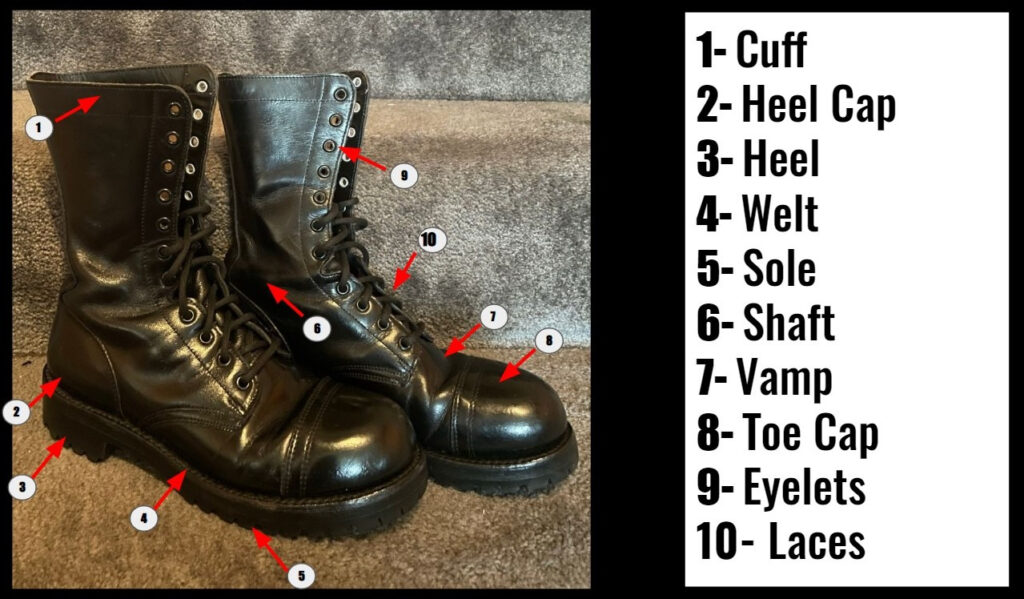
- Toe cap and heel cap are where you build a high shine. They don’t bend, so the wax won’t crack
- Keep oils, polish and solvents off rubber soles and welts. They make rubber swell and go soft
Products
A more extensive list is over at my bootblacking kit page. List is in order of use
Stripper
- It’s not a cleaner. It takes off polish, wax and the finish, sometimes the dye too, so only use it if you’re redoing the finish
- Wipe it onto a clean part of the cloth often, or you’ll just spread the old polish around
- Chemical and harsh, also removes oils, so reconditioning is a must after. Wear gloves and work somewhere ventilated, it’s very flammable
Cleaner
- Removes dirt
- Usually unscented glycerin soap but it depends on the leather type
- Saddle soap works in some cases, but it’s a stronger soap with wax in it and it can leave a film. Some have rosin (pine resin), a common allergen. Keep it off suede, nubuck and patent
- Cleaning leather can darken it while it’s wet. That fades as it dries, but uneven wetting can leave water marks on unfinished leather
Conditioner
- Contains oils/waxes that lubricate the fibers near the surface, protect, and even out the color. Leather doesn’t really lose its oils from normal wear, so it doesn’t need conditioner every time
- Heavier conditioners have more oil and/or wax, and less water
- Over conditioning can cause leather to stretch, soften and lose its shape. It can also darken it and leave it greasy. This is one of the hardest things to undo.
Preservative
- Water resistance, wear and dirt protection. It’s not true waterproofing, it wears off as the boot flexes
- Wax is the most common
- Polishes are in this category but they aren’t the only option. A suede protecting spray would fit this category. Spray those outside and away from faces, the mist is bad to breathe.
- Shine comes from buffing wax into a thin, even layer that fills the grain. Pressure and a bit of warmth from friction soften the wax so it spreads (it doesn’t actually melt)
Other
Outside of the scope of this class a bootblack might have an extensive kit for a variety of situations. We don’t only clean boots:
- Products for latex care/shine
- Tools to deal with suede (brush, waterproofing spray)
- Products for non leather shoes: sneakers care
- Specialized cleaners for more advanced care (70% alcohol to disinfect…)
- Repair supplies for when we are dealing with clothes
- Wax crayon or china marker for colored sole stitching
Kit basics
- Horsehair buffing brush (2 preferably, one for dirt, one for polish, so grit doesn’t scratch your shine)
- Dauber brush for cleaner
- Cotton cloths (to clean the brush, remove cleaner from shoes…) and nylons (to bring shine)
- Conditioners (at least one heavy for boots, one lighter for clothes and for before polishing)
- Hard polish
- Water spray
- Lighter for frayed synthetic stitching. A quick pass, and keep the flame off the leather
- Nitrile gloves
Technique
Gather information
- What is the gear used for
- Has it been in contact with bodily fluids (if so, see Disinfect)
- How has it been cared for in the past
- What are your preferences for care
- What type of leather is it
- If you are working on lighter boots, warn about darkening the leather during the process
- Ask if they have a preference for any products
Plan
- Maybe you need to take the item as a home project
- Figure out logistics (how to avoid getting polish on the customer, how are you going to handle dry up time, do you need to wear gloves…)
- Decide on the order you are going to do the following steps and ready your supplies
- Test any new product on a hidden spot first, like the tongue under the laces. For home projects, give it a day to see how it dries
- We don’t only bootblack in public. Taking projects home allows for more involved leather care
Unfasten
- Always ask first! Roll up their cuffs and protect their socks. And take a picture if you think you’ll forget how the boots were laced
- Assess if laces need cleaning or repair
Clean
- Brush off dust and dirt first, grit is what scratches. Scrape caked mud off the soles, then wipe
- Lather soap and work it in. Wipe it off with a clean damp cloth and don’t get the boots too damp
- Let them dry completely before conditioning. Never speed it up with heat (hairdryer, radiator), it shrinks wet leather for good
- Examine the stitching for possible touch-ups
Disinfect
- Only if the gear has been in contact with bodily fluids
- Wear nitrile gloves and treat any fluid as infectious, whatever you’ve been told
- Clean first, disinfectant doesn’t work through dirt. Throw the cloth away after
- Mist or wipe with 70% alcohol (ethanol) and let it sit, don’t wipe it dry right away. Test it on a hidden spot first
- Recondition after, alcohol strips oils
- No bleach on leather, it will ruin it
- Keep separate brushes and cloths for this, and replace them after
Condition/polish
- Apply conditioner like a massage, in thin coats, and make sure it’s absorbed before moving on. Wipe off whatever doesn’t absorb. You can use gloves, cloth or your bare hands based on preference
- Wax won’t build a shine over fresh conditioner. Use a light one if you’re polishing right after, and for home projects let it rest overnight
- Polish in thin layers, going back and forth between boots so each layer has time to dry. Hard wax on the toe and heel caps, cream on the rest
- Be wary of over conditioning braided gear like whips, they get floppy and lose their shape. Keep conditioner off the knots
Buff
- Buffing helps get rid of excess product, and the pressure and friction bring a shine by smoothing out the wax
- Touch up stitching
Hardware
- Make sure you clean the polish from the metal hardware. A metal polish brings the shine back, but it’s abrasive, so keep it off the leather and rubber
Refasten
- After everything is back into place ask the owner if they need something else done
Negotiations and setting up a scene
Negotiations
- As part of your conversation about the item’s specifics, ask about the meaning of the item for the owner. What is the history there?
- Ask about allergies and/or medical conditions if it could be relevant. Common ones in our products: pine (rosin, pine tar, turpentine), beeswax, lanolin, nut oils, fragrance, and nickel in hardware
- Ask about any limits
- Not everyone wants a scene from the interaction! If you feel a connection, ask about what you want, both if you are sitting on the stand or caring for the gear. Take rejection gracefully and don’t make assumptions. The only thing you are entitled to are some cleaner boots!
Bootblacking and Power dynamics
- Everyone bottoms for a bootblack. They are the expert, you follow their lead. Be respectful of this
- Some may assume that as a form of service, bootblacking is submissive, but any practice can belong to any role if you are creative enough
- If you are dominant, be in control of the person’s position. Tie them up, manhandle them, sit on top of them. Put their foot where you want them
- If you have negotiated physical touch, groping, massaging or teasing are great options
- You can talk the customer down for the state they brought their boots in, and punish them for it
- Your brushes are great impact tools and you can do bondage with laces!
- If you are submissive, you might want to expect punishment if you stain them with polish!
- Bootlicking is an option, but beware of product toxicity. Nothing we use is made to go in a mouth, so lick a finished boot that’s been buffed until the cloth comes away clean, not fresh product. And never the sole or welt, they carry a lot of bacteria
- Conditioner can be applied with other body parts (be creative!)
- You can negotiate with the person sitting for you for them to put their boots somewhere they see fit that might not be the most convenient for you.
- Bootblacking is at heart an act of service, it’s easy to make a scene out of care, devotion and/or worship
Sources
Beyond Bootblacking – Daddy Wendell
From Shaft to Sole: Bootblacking 101 Handout – Creature
Bootblacking 101 – Class Notes, Resources and Citations – Daisy Blue